Ringing the bell after your last radiation session is a moment to savor, and for most breast cancer survivors, the hard part truly is behind them. However, some women do experience changes in the treated breast or chest wall months or years later. Knowing what those changes look like helps you catch them early, when they respond best to treatment.
A review of the delayed effects of radiation in breast cancer survivors found that radiation may contribute to lasting pain in the breast, arm, and shoulder in up to 30% to 50% of patients three to five years after treatment. A smaller group, fewer than 5%, develops moderate to severe tissue damage that can lead to hardening, skin breakdown, or wounds that will not close.
Read on to learn more about the timeline of delayed injury, how to tell normal changes from warning signs, and where to get help for radiation injury after breast cancer treatment in Cumming, GA.
Why the Risk Doesn’t End With Your Last Radiation Session
Radiation destroys cancer cells, and it also injures the tiny blood vessels in the healthy tissue around them. Your body can usually repair much of that damage in the first few weeks. However, the deeper vessel damage can continue to progress slowly, narrowing blood flow little by little for years.
As blood flow drops, the breast and chest wall receive less oxygen. Radiation-damaged tissue starts to thicken, stiffen, and lose its ability to repair everyday wear and tear. Doctors call this delayed radiation injury, and in its more serious forms, soft tissue radionecrosis or radiation fibrosis.
The timing of this condition varies from person to person. Radiation dose, the size of the treated area, smoking, diabetes, and other health conditions can all affect when and whether symptoms appear.
What Does a Delayed Radiation Injury Look Like?
Every survivor's experience with breast pain after radiation is different, and late changes tend to follow a general pattern.
- First three months: Redness, peeling, tenderness, and fatigue are normal side effects of radiation. These symptoms usually fade within a few weeks after your last session.
- Six months to two years: For many women, this is when firmness, swelling, and skin thickening in the treated breast first appear. Small changes in breast shape or size can also show up within this time frame.
- Two to five years: Hardening of the tissue, called fibrosis, can continue to build during this stretch of time. Research on breast radiation shows that most fibrosis develops within the first four years, and the most severe cases can take longer to appear.
- Five to 10 years and beyond: Tissue that seems stable can still break down after a minor injury, a biopsy, or surgery in the treated area. Chest wall pain, thin and fragile skin, and wounds that will not heal can appear more than a decade after treatment.
Normal Tissue Changes vs. Delayed Radiation Injury
Some changes after receiving radiation therapy are expected and tend to stay the same over time. These include:
- Skin that stays slightly darker or firmer than the other breast
- A small change in breast size or shape
- Mild numbness near the surgical scar
Changes that keep getting worse deserve a closer look. Call your care team if you notice:
- New or growing pain in the breast, chest wall, or armpit
- Hardness that spreads or makes the breast feel tight
- Skin that thins, cracks, or breaks open
- A sore that stays open for several weeks
- Drainage, bleeding, or swelling in the treated area
- Trouble lifting your arm or moving your shoulder
- New or changing medical conditions, even if you don’t believe it has anything to do with your previous radiation treatments
Some of these changes can also point to an infection or a cancer recurrence, so your oncologist should always evaluate them first.
Questions to Ask Your Oncologist at Every Follow-Up Visit
Follow-up appointments with a radiation oncologist tend to focus on checking for cancer rather than the effects of radiation therapy or long-term side effects. Set aside part of that time to talk about the treated tissue too. Bring up:
- New or changing skin, pain, or swelling, along with photos that show how it has changed
- Wounds or sores in the treated area, even small ones
- Any planned biopsy, reconstruction, or other procedure in the treated area
- Changes in how your arm or shoulder moves
- Whether speaking to a hyperbaric physician makes sense for you
Additionally, you should tell every new provider that you had radiation, even if it was 15 years ago. Tissue in a radiation field heals more slowly, and planning ahead can prevent complications. Women searching for the best delayed radiation injury treatment in Cumming should always look for a team that pairs hyperbaric medicine with a physician-led team and comprehensive wound care.
How Can Hyperbaric Oxygen Therapy Help Radiation-Damaged Tissue Heal
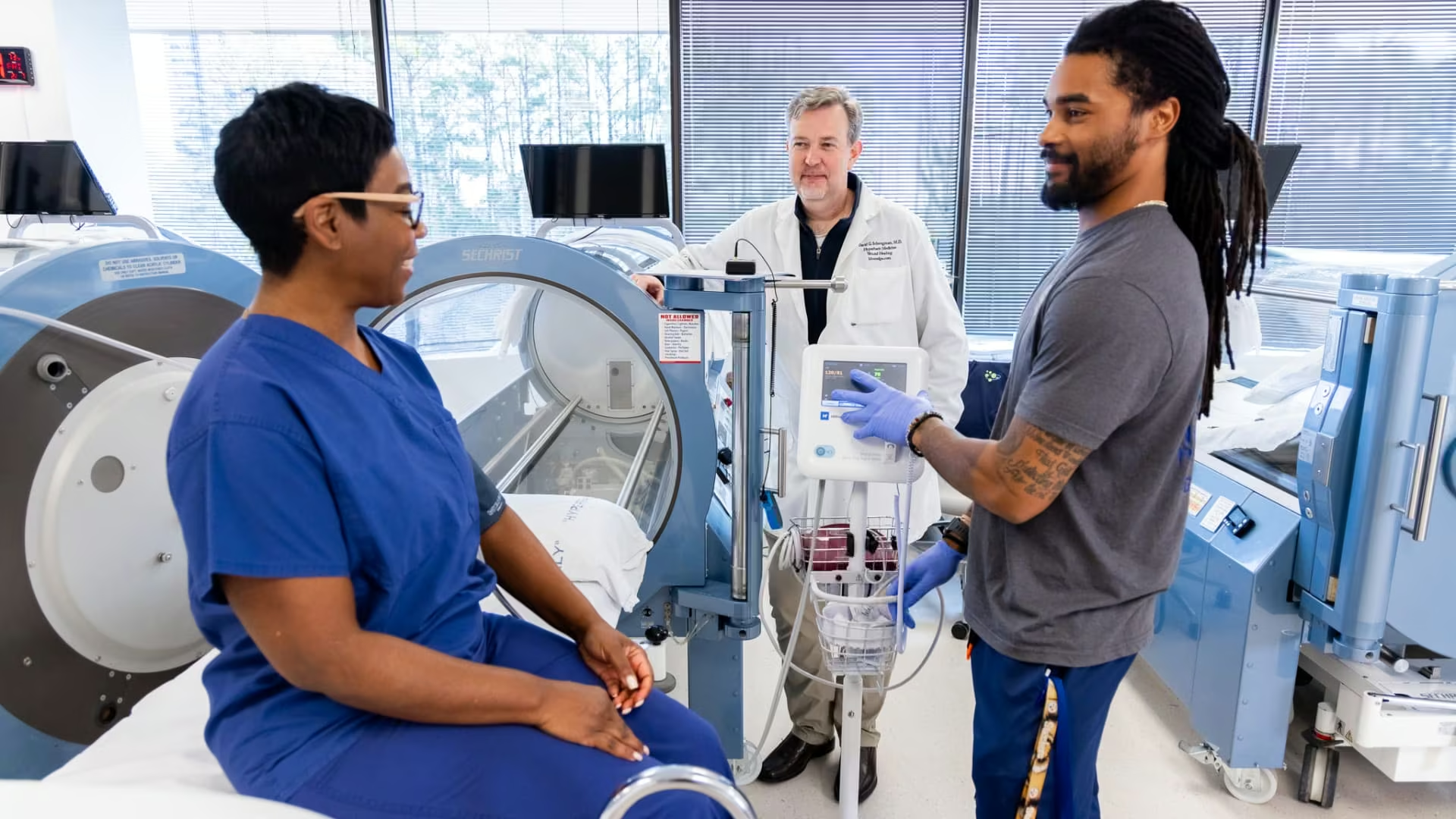
Hyperbaric oxygen therapy (HBOT) treats the oxygen shortage behind delayed radiation injury. During each HBOT session, you rest in a pressurized chamber and breathe 99.7% medical-grade oxygen. The added pressure lets your blood carry far more oxygen than usual, which prompts your body to grow new blood vessels in the damaged area.
Most treatment plans include daily sessions, five days a week, over several weeks. As blood flow returns, pain and swelling can ease, and stubborn wounds get a real chance to close. For anyone comparing options for the best radiation injury treatment after breast cancer in Cumming, HBOT works best as part of a plan that includes wound care and close contact with your oncologist.
Where to Find the Best Radiation Injury After Breast Cancer Treatment in Cumming, GA
Hyperbaric Physicians of Georgia has cared for patients with delayed radiation injuries in Metro Atlanta, North Georgia, and across the Nation since 1993. Our Cumming clinic location Medical Director, Joni Hodgson, DO, is board certified in family medicine and subspecialty board certified in undersea and hyperbaric medicine. She completed her undersea and hyperbaric medicine fellowship at Brooke Army Medical Center, later served as associate program medical director there, and still serves as a senior flight surgeon with the Air National Guard. Our Program Manager, Terri Chio, LPN, CHT, CWCA, has worked with our team in wound care and hyperbaric medicine since 2005.
At our state-of-the-art facility in Cumming, our team pairs physician-led wound care with hyperbaric therapy accredited with distinction by the Undersea and Hyperbaric Medical Society (UHMS) since 2017, with a 100% safety record since we began in 1993.
No matter how many years have passed since your last radiation session, it is not too late to get answers. Schedule an appointment with Hyperbaric Physicians of Georgia for radiation injury after breast cancer treatment in Cumming, GA.